‘All the Devils are Here’ features a bone-chilling performance from Patrick Page
In his new one-man show, Patrick Page performs the haunting monologues and scenes from Shakespeare’s most notorious villains





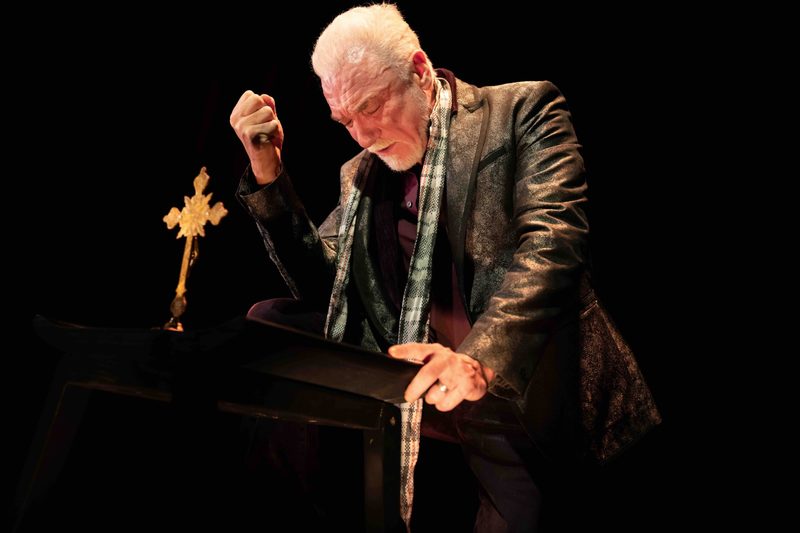
Photo courtesy of Julieta Cervantes
★★★★☆
All the Devils are Here: How Shakespeare Invented the Villain
Created and performed by Patrick Page
Directed by Simon Godwin
ArtsEmerson
Oct. 28 – Nov. 1
We hold high expectations for the villains of our shows, movies, and books. They must be complex, believable, interesting, and entertaining. But where do these expectations come from? Patrick Page argues that they originate from William Shakespeare.
In the 15th and 16th centuries, morality plays, a type of allegorical drama, were flourishing across Europe. These plays often featured a vice character: a stock character representing an agent of the Devil that tempts the main character into evil. Shakespeare, who began writing in the late 16th century, challenged this popular depiction of evil. Shakespeare was interested in the insidiousness of evil, how it slips quietly into the hearts of men and corrodes them slowly from the inside into something unrecognizable. As such, Shakespeare’s villains are unlike any others that came before them — because Shakespeare’s villains are human.
This remarkable fact is what Page aims to celebrate in his award-winning one-man show, All the Devils are Here: How Shakespeare Invented the Villain. Throughout the show, Page tracks the evolution of Shakespeare’s villains from the somewhat conventional Richard III and Aaron the Moor to the unsettlingly realistic Claudius and Macbeth. With humorous commentary and precise analysis, Page guides the audience through the theme of evil in Shakespeare’s works.
Page, who won a Grammy for his portrayal of Hades in Hadestown on Broadway, is an associate artist with both The Old Globe in San Diego and the Shakespeare Theater Company, where he has starred as King Lear, Prospero, Macbeth, and many others. Here, he once again returns to his element to reveal the fascinating ways Shakespeare exposed the depths of human evil over 400 years ago.
Page created an arresting theatrical experience, assembled with the most frightening and haunting scenes of the Shakespearean canon. His stage presence is magnetic, his voice is exquisite, and his brilliant acting of Shakespeare is born from a precise and nuanced analysis of the Bard’s most complicated characters. Page’s ability to effortlessly switch from character to character in a single scene through mere changes in posture and tone is especially incredible.
The entire show is acted brilliantly, but a few scenes stand out. There is something particularly haunting about Page’s performance of Claudius in the prayer scene taken from Hamlet. Page renders Claudius’s heart-rending grief and shame with beautiful clarity, and the staging, though simple, is powerful.
Page’s portrayal of the scene between Iago and Othello is yet another tour de force and an example of his remarkable ability to switch characters in the space of a breath. Page’s portrayal of Iago as a sociopath is both smart and frightening. In this notorious scene of deception, with none of the legwork of the previous acts of Othello to help him, Page somehow manages to communicate both Iago’s chillingly dispassionate cunning to the audience while also maintaining the believability of Othello’s inability to detect Iago’s evil.
The show, understandably, devotes the most focus to Lord and Lady Macbeth and their tragic descent into evil. Page captures the character’s turmoil and fear in all of these scenes, but his performance is especially gut-wrenching and terrifying for Macbeth’s lines “Glamis hath murdered sleep.” The staging and the lighting in this scene thrust the audience into Macbeth’s newly horrifying world, where the night is hideous and the monster is himself.
Page finishes his Shakespearean tour through the horrors that wreak havoc on the human soul with Shakespeare’s last play; Prospero, fittingly, bids the audience farewell with the speech that narrates his decision to choose forgiveness over villainy and embrace his own mortality. With this faint beacon of hope, Page’s harrowing and brilliant journey through the villains of Shakespeare ends, and the audience is left to ponder what may be lurking in their own souls.