BSO’s ‘The Nutcracker’ and ‘Eugene Onegin’ previews January Tchaikovsky festival
Hilary Hahn and Seth Parker Woods also presented Simon’s ‘Double Concerto Suite’





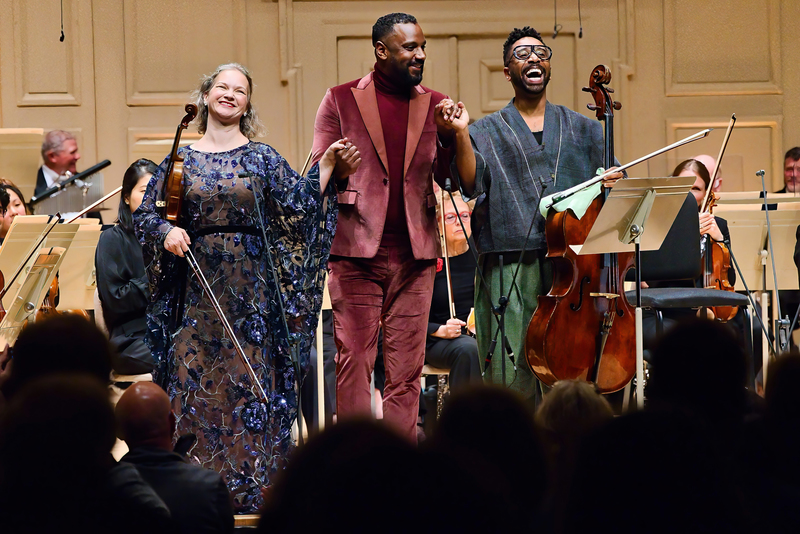
Photo courtesy of Hilary Scott/BSO
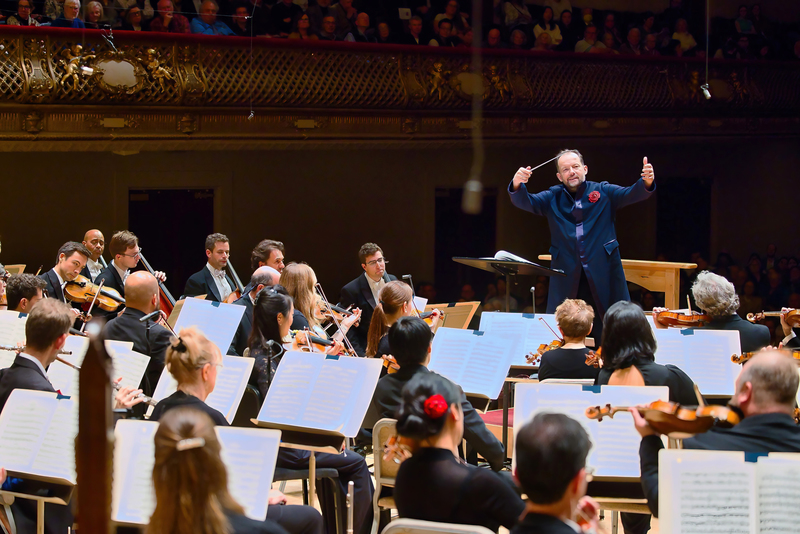
Photo courtesy of Hilary Scott/BSO
Tchaikovsky’s Polonaise from Eugene Onegin, Simon’s Double Concerto Suite, Tchaikovsky’s The Nutcracker: Act II
Conducted by Andris Nelson
Featuring Hilary Hahn and Seth Parker Woods
Boston Symphony Hall
Oct. 17, 2026
It has long been debated whether theatrical repertoire, such as opera and ballet, can suffice as standalone listening experiences. The Boston Symphony Orchestra’s (BSO’s) program from last weekend made a convincing case that, lest no other composer, Tchaikovsky can. On Oct. 17, the BSO performed two contrasting pieces from Tchaikovsky’s theatrical repertoire, “Polonaise” from Eugene Onegin and The Nutcracker, Act II, with Carlos Simon’s Double Concerto Suite sandwiched between them.
Under Andris Nelsons’s thoughtful conducting, the BSO opened with a bright and triumphant performance of the “Polonaise.” The opera is quite different from the “typical Tchaikovsky”: one might expect the soaring melodies of Swan Lake or his roaring symphonies, but Tchaikovsky knew that an opera must serve its story. The “Polonaise” reflects an intent to convey Pushkin’s novel in verse Eugene Onegin, which portrays rather ordinary people and their common concerns in contrast to other Russian operas that celebrate some grand heroic. The BSO’s performance was lighthearted and regal, an accurate depiction of the brilliant Polonaise scene that introduces the party scene of a rich social world.
Carlos Simon’s Double Concerto Suite was commendable. Simon, a highly acclaimed modern composer, addressed the audience from the stage beforehand, describing the massive undertaking of writing for Hilary Hahn and Seth Parker Woods. The performance itself was solid. The initial movements of Simon’s composition evidently drew on Vivaldi and Bach; the sound was highly reminiscent of Baroque passacaglias for violin and cello. However, it didn’t resonate as especially unique, and the extended passages with solo violin and cello in octaves felt unconvincing.
The latter portion of the composition, inspired by the Delta blues, was distinct and brilliant. It’s unclear what prompted such a sudden change in style, but it came at the perfect time. Throughout, Hahn and Woods’s performances were excellent. Hahn’s famous pristine, singing sound rang out clearly. Woods set a great foundation and anchor for the solo parts, maintaining a high level of technical skill. Unfortunately, Symphony Hall has always dampened the lower register, and this weekend was no exception; the cello in its lower register often got lost within the BSO’s accompaniment.
The second half of the program brought the second act of Tchaikovsky’s beloved Nutcracker to Symphony Hall. Clarity and quality were at a very high caliber. The Divertissement offered precision and excitement, especially during the brisk “Trepak” (Russian Dance) and “Tea” (Chinese Dance), where the strings played in impressive unison and the winds floated above the orchestra beautifully. In “Waltz of the Flowers,” the brass sat in a distinct layer above the rest of the orchestra, producing a rich, intriguing sound. The “Pas de deux,” as it always is with its heartfelt melody, was deeply emotional. Nevertheless, the BSO truly distinguished themselves during “Dance of the Sugar-Plum Fairy.” Only the first few stands of each string section performed the movement, highlighting the breathtaking performance of the celesta, which carefully emulated the delicate nature of Tchaikovsky’s composition. The performance was stellar and left the audience wanting to hear Act I.
During the standing ovation, the audience roared for principal harpist Jessica Zhou. After an extended ovation with multiple curtain calls for Nelsons, the conductor spoke from the podium, underscoring the power of music and the heart it brings to a divided world. This weekend’s program wraps up Nelsons’s fall residency with promising anticipation. The BSO’s next concert cycle features Tchaikovsky’s six numbered symphonies and his opera The Queen of Spades. It was almost as if this weekend’s program was a sample, inviting us into what next year has in store.