The science of bouncing back
How Ali Truwit used cognitive science and psychology to go from shark attack to Paralympic medalist





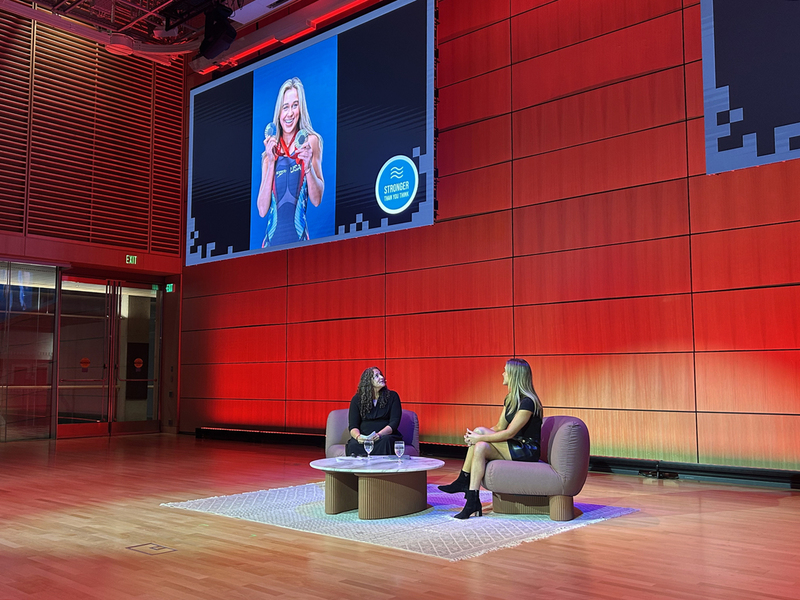
Lauren Adler–The Tech
In 2023, Alexandra “Ali” Truwit graduated from Yale University as a student-athlete with a double major in Cognitive Science and Behavioral Economics and a five-year plan. She had a job lined up at McKinsey & Company, and she planned to attend Harvard Business School through its deferred-enrollment MBA program.
Two days after earning her diploma, Truwit went on a celebratory trip to the Turks and Caicos Islands with her fellow Yale swim teammate and close friend, Sophie Pilkinton. They were swimming side by side and snorkeling in the Caribbean Sea, as they had done countless times before, when a shark attacked Truwit’s leg. They called for help, but no one came. Truwit and Pilkinton swam for their lives back to the boat, where Pilkinton — now a medical resident at Vanderbilt University — applied a tourniquet and saved Truwit’s life. Days later, on her 23rd birthday, Truwit underwent her third surgery of the week: a trans-tibial amputation.
On Oct. 14, Truwit joined Dr. Lauri Santos, professor of Yale University’s most popular class ever, Psychology and the Good Life, and host of The Happiness Lab podcast, for a live taping at the Boston Museum of Science. The event marked the opening of the William and Charlotte Bloomberg Public Science Common, the museum’s newly completed events venue. Their conversation focused on Truwit’s recovery, the cognitive science and psychological strategies she used throughout the process, and her mission to turn her traumatic experience into something positive through her nonprofit, Stronger Than You Think, which advocates for prosthetic access, water safety, and equity in the Paralympics.
A new way forward
Practicing radical acceptance has been key to Truwit’s journey. The practice involves accepting reality as it is and recognizing that what has happened cannot be changed. It doesn’t mean ignoring what one has been through; it means acknowledging that it has already happened. Truwit described how this helped her stop fighting the reality of her injury and shift her focus to new possibilities that may await her in the future.
“I don’t like what happened to me. I don’t wish it happened to me. Though my reality is, it’s happened to me. So either I stay angry, fight this reality, and keep myself stuck, or I radically accept that this is my reality,” Truwit said. “In doing so, I open myself up to new paths, new futures, [and] new opportunities.”
She also noted how important “holding the dialectic” has been in the process: recognizing that deep grief and pain can coexist with genuine gratitude and joy. “I really tried to cling to those glimmers of hope and joy, and realize that both of those can exist at the same time. And if I make room for both of them to exist, this will grow, and I will have those moments of joy,” Truwit said.
A little over a year after the shark attack, Truwit competed for Team USA at the 2024 Paris Paralympic Games, winning two silver medals in S10 Swimming. From the outside, Truwit’s recovery seemed smooth and rapid; on the inside, though, nothing could have been further from the truth.
“The actual science of recovery involves backtracking, and it’s slow,” Santos said after Truwit described her first return to the water following her amputation. The former Division I swimmer had begun by dipping just her toe into her backyard pool, wearing a floatie around her waist. She and her family weren’t sure how she would respond to returning to the water — a place she had once loved, but also the site of the traumatic attack.
Next, Santos and Truwit discussed distanced self-talk: using second- or third-person phrasing to ease cognitive burden and emotional reactivity. The concept is closely linked to a growth mindset — the belief that one’s current situation isn’t permanent and can change. Examples include, “You’re being too hard on yourself, Ali,” or adding “yet” to a statement: “I’m not where I want to be… yet.” Truwit used this skill to ground herself during difficult moments, reminding herself that progress is possible even when the present feels especially challenging.
Using purpose to bounce back stronger
Santos ended the conversation by turning to the current chapter of Truwit’s story: her work with her nonprofit, Stronger Than You Think, which has pledged and donated $1.3 million dollars, donated over 50 prosthetics to girls and women; directed $650,000 to Paralympic athletes; and offered thousands of hours of swimming lessons to youth. Santos introduced the concept of Post-Traumatic Growth (PTG), distinct from Post-Traumatic Stress: the idea that people can experience positive psychological changes and find new purpose after severe adversity. Truwit has experienced this through giving back, and her advocacy reflects a broader, science-backed theory: altruistic, action-oriented work for others can significantly support emotional recovery.
Looking ahead, Truwit is focused on expanding her nonprofit’s reach and impact while setting her sights on making Team USA for the second time at the 2028 Olympic Games in Los Angeles. She knows there is no guarantee the journey will be easy, but she has built a repertoire of science-backed skills to help her stay resilient day-to-day. Truwit shared her personal motto, “permission to feel, intention to reset” — a reminder to give herself space to experience negative emotions while also making a plan grounded in active hope to begin again and plan forward-moving action.
“I’m stronger than I think, and I hope that for all of us,” Truwit said. “I think we have so much more capacity within us than we might ever realize, and if we open our minds to it, we’ll surprise ourselves.”