Co-design in action: A deep dive into MIT Assistive Technology Club
From wheelchair modifications to a camera-based rideshare finder, the co-designer is the center of the design process





Jojo Placides–The Tech
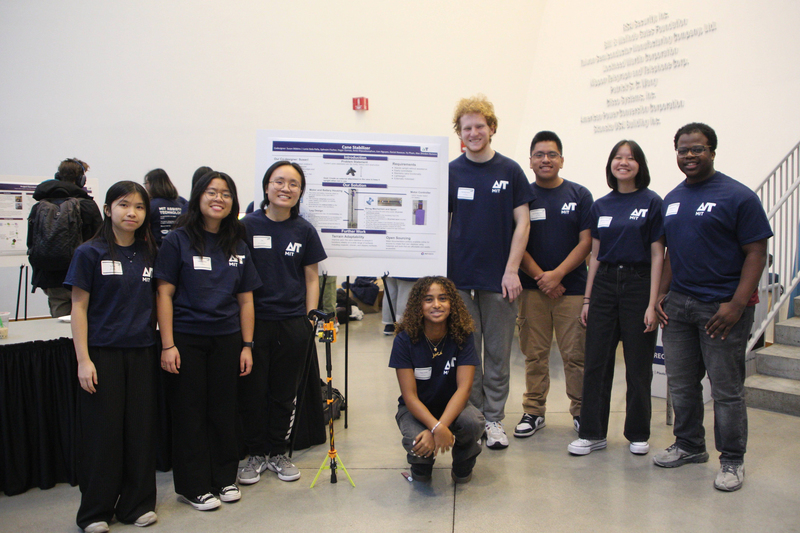
Photo courtesy of Tage Mehta
Imagine this: You have low vision, and have just requested a ride home. Amidst blaring city sounds, your phone blurts out, “Your driver has arrived,” and your rideshare is only a few feet away. Unfortunately for you, those few feet can make all the difference. You reach out again and again, struggling your way towards the car. There’s a serious risk that you’ll slip, fall, and get injured, but what other choice do you have?
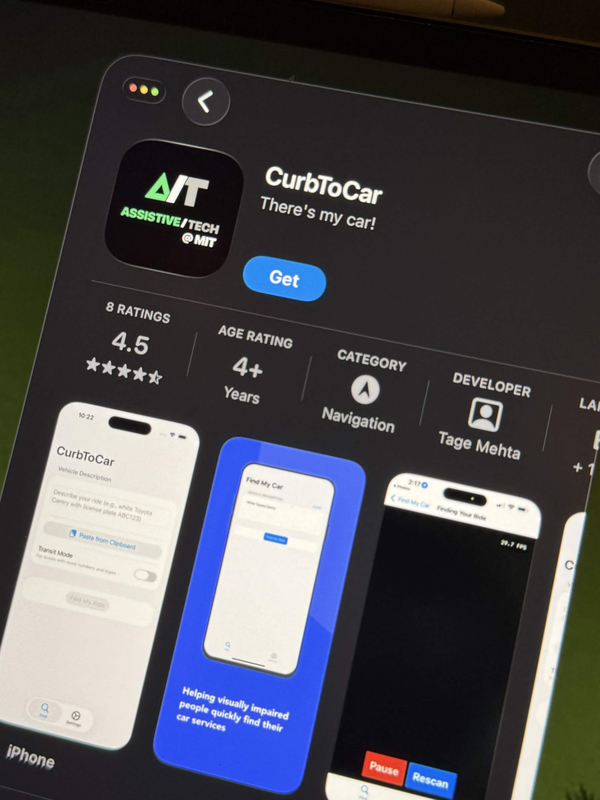
MIT students designed CurbToCar to solve exactly this problem. The app uses object detection and continuous audio cues to safely guide its user towards their ride, and it has over 3,500 downloads on the App Store, with reviews praising its accuracy and intuitive interface.
CurbToCar is one of many projects built not only for but with those with disabilities as part of the MIT Assistive Technology Club (AT@MIT).
AT@MIT started out as MIT’s Assistive Technology Hackathon (ATHack) in 2014, but ended during COVID. It was brought back as a new Edgerton Center build team in fall 2023; today, the club consists of over 60 students grouped into eight teams.
At the beginning of the semester, AT@MIT reaches out to the community, looking for disabled members who are interested in talking about their challenges. That person becomes a co-designer, someone who works with the build team to shape the product instead of just receiving it.
“The goal of any project is to build something that the co-designer can take home and will tangibly improve some aspect of life, big or small,” AT@MIT co-president Tage Mehta ’28 told The Tech.
Whether in-person or online, getting to know the co-designer and their expectations is an integral first step.
“Sometimes they come with a drawing that they’ve made,” said Abbas Darwich ’28, an AT@MIT member who is currently working on a foot-controlled PlayStation 5 game controller for a Ukrainian veteran who lost his arm and three fingers. “As the engineers, our job is to say what’s feasible and create a list of the must-haves in the design. Then we go and design it.”
Ben Lou G, a Physics PhD student at MIT who served as AT@MIT vice president as an undergraduate student, is the co-designer for two projects, each designed to fit one of his needs in his everyday life.
First, Lou, who is wheelchair-bound, needed a modification to his wheelchair to easily switch between its computer and tray without requiring much physical exertion. His range of motion is very limited due to his muscular atrophy, making common tasks in his everyday life difficult.
The team knew that they needed to design a device that Lou could control with minimal physical effort and would uniquely fit his setup. However, it should not impact him going through doorways, nor should it make him stray far from his current mobility habits. After constructing a manual prototype to investigate the mechanics of the device, as well as an automated prototype that uses a joystick, the team came up with a final design which was shown at AT@MIT’s Spring 2026 Final Project Showcase.
Second, as a physics researcher, Lou spends a lot of time writing equations for papers using the formatting language LaTeX, which is another difficult task due to his limited finger mobility. To address this, the team created an AI-enabled speech-to-text system for LaTeX, seamlessly integrated into Overleaf. This was also shown at the aforementioned final project showcase.
Another project focused on designing a cane stabilizer for a co-designer whose fibromyalgia and hemiparesis forces her to use a cane in her day-to-day life. Cane stabilizers in the market are too bulky and obstructive for convenient day-to-day use, so the co-designer needed a more compact and lightweight external attachment that would stabilize the cane. The AT@MIT team went through numerous prototypes before deciding on a cane that uses a string and motor mechanism, so that it can stand on its own with the press of a button.
“You might be a semi-expert in engineering,” Mehta explained, “but the co-designer is the expert in what they need, so they’re really a core part of our build team.”
In the case of CurbToCar, two tech-savvy adults with limited vision needed a way to find their drivers whenever they requested a rideshare. On paper, the app seemed to work flawlessly: it would identify the car’s make, model, license plate, and provide spatial sound cues to guide them toward the driver.
However, the app lacked the “high accuracy and reliability in order for someone to use our app,” said Mehta. Realizing this, the team used traffic camera footage to train their car identification program, improving the technology sufficiently.
On the foot-controlled game controller, Darwich reflected that the project gave him an opportunity to improve his technical skills.
“Our design was initially very complicated and involved a microcontroller and a lot of different sensors and peripherals, but upon further research this semester, we were able to find some off-the-shelf products that would vastly simplify our engineering approach,” he said. “That’s one of the important lessons that being a part of AT@MIT has taught me: to keep things simple.”
The engineering behind designing tools for people with disabilities is more complex than many realize. Part of that is because at AT@MIT, the design and engineering process directly involve the people the project is for. From ideation to prototype to final product, the whole design process is informed and guided by people who will directly benefit from this work, helping bridge the gap between life-changing technology and its users.