Physics, fluids, and frits
The science and significance of the 25th Great Glass Pumpkin Patch





Jieruei Chang–The Tech
Jieruei Chang–The Tech
Jieruei Chang–The Tech
Jieruei Chang–The Tech
On Oct. 24, 2,000 pumpkins will sprout from the lawn of Kresge Oval. Their bodies will be plump and vividly colored, and their stems will curl in whimsical spirals. They will be made entirely out of glass.
This is MIT’s Great Glass Pumpkin Patch, which is celebrating its 25th anniversary this year. The 2,000 pumpkins sold in the pumpkin patch were created in MIT’s own Glass Lab, hidden underground beneath the Infinite Corridor. Bringing them to life requires an interplay of fluid dynamics and physics, chemistry and materials science, and a good sense of creativity.
In the lab, students and instructors create a vibrant and close-knit community. Together, they shape their passion into beautiful artwork, offering students a refreshing break from rigorous lectures and coursework.
“Glass blowing is a very process-oriented work, so I think it fits an engineering mindset,” instructor Whitney Cornforth ’01 said as he manipulated the molten glass, effortlessly shaping it while answering interview questions.
Cornforth’s own journey with glass started as an MIT undergraduate studying Naval Architecture (Course 13 at the time). It’s not directly relevant, he admitted. However, engineering and glassblowing are surprisingly similar: there is a goal, and by working backwards with well-defined steps, a process can be designed to achieve that goal.
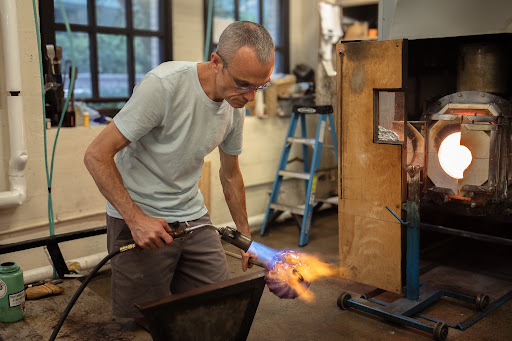
The process of growing a glass pumpkin begins with a gather ― a volume of honeylike viscous glass drawn from a crucible ― on the end of a long and hollow metal blowpipe. The gather’s temperature reaches about 2,160°F, at which point the glass is still hard enough to not collapse under its own weight but still molten enough to be molded into shape.
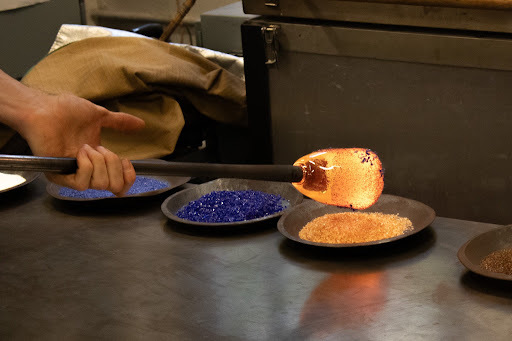
To imbue the pumpkins with vibrant hues, the gather is rolled in little glass fragments called frit. Each frit has a different color based on the different transition metals incorporated into the glasses while creating it. For example, red frit has copper ions, and golden frit is colored by the chromium incorporated into the silica during its formation process.
The gather is stamped into a star-shaped mold to form the ridges. At this point, it looks somewhat like a deflated basketball. The next step is to give the pumpkin its plumpness. Air is blown into the end of the pipe, applying pneumatic pressure and pushing the inner wall of the glass outwards. Traditionally, this air was blown by mouth, but during the pandemic in 2021, the Glass Lab built a compressed air system to automatically blow air down the pipe. While this approach might be more sanitary and at times more convenient, it is not a perfect replacement.
“MIT students love to mechanize everything,” Cornforth quipped.
But humans can be much more flexible and adaptable than a compressed-air machine. “Good luck replicating every job on the computer. I can ask Alfonso 1,000 different things today,” Cornforth said. He rattled off various methods of blowing air down pipes: short bursts, long sustained heaves. “He can do them all.”
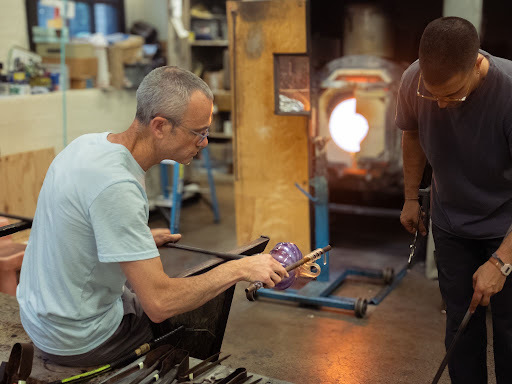
“Alfonso” is Alfonso Parra Rubio, a PhD candidate at the MIT Center for Bits and Atoms, as well as Cornforth’s glassblowing assistant for the day. While Cornforth was blowing the body of the pumpkin, Rubio had been hard at work putting together the pumpkin stem.
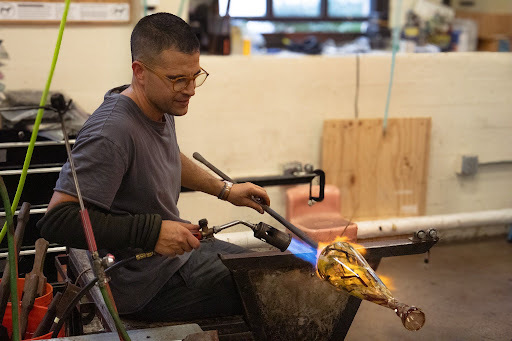
For the stem, a tiny amount of physics knowledge comes in handy. By varying the heating profile of the stem, different parts of the glass can be given different material working properties. The part of the stem that will attach to the body needs to be hot in order to expand and bulge outwards, while the long and thin part of the stem needs to be relatively cool to remain structurally stable.
Cornforth and Rubio married the body and stem together. As it cooled, the stem was quickly twirled into shape, giving the pumpkin its characteristic fantastical tendrils.
As a final flourish, Cornforth used an oxygen-poor flame to heat the stem, which had previously been rolled in frit. In order to burn, the flame pulled the oxygen atoms from metal oxides in the glass. Stripped of their oxygen atoms, the metals formed tiny metallic crystals on the glass surface, creating a brilliant golden luster.
The pumpkin was put in the annealing oven to cool. Fluid dynamics had shaped it, transition-metal chemistry had colored it, and thermodynamics had solidified it. But maybe the point of the Glass Lab is not just the science.
“It’s a high-stakes environment where things can go wrong, and you need to problem-solve on the fly, and be able to express ideas and receive them,” said Cornforth.
The Glass Lab helps provide a temporary respite from academic courseloads and take MIT students’ minds off of work. Glassblowing is “an activity that forces you to give your entire attention,” said Conforth.
Of course, the point is also to make art, to let human creativity shape objects in real life. “Why a pumpkin?” Cornforth asked. “I think it’s because it does something that we don’t expect glass to do.”
Not everything needs to be practical, Cornforth said, even if it is created with strong scientific principles. “People love to ask the question: what does it do? Maybe the thing it does is to make people smile.”