Possessing individuality and community: The Dispossessed by Ursula K. Le Guin
Le Guin explores the relationship between community, homeland, and shared humanity





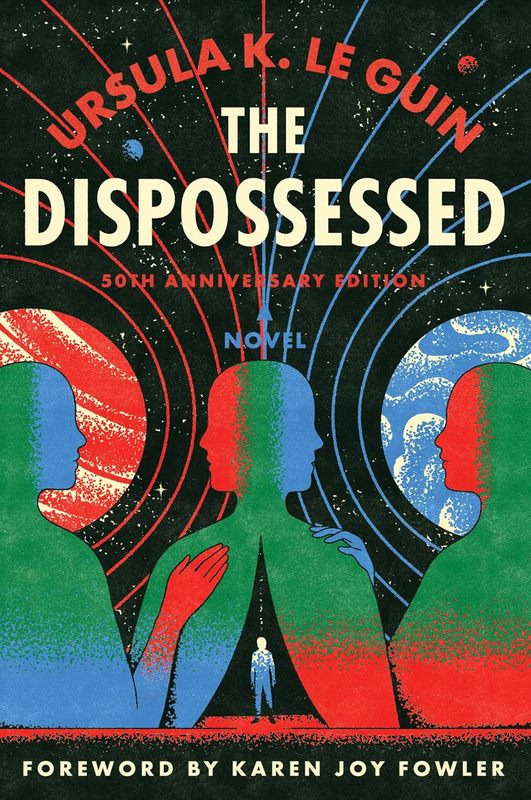
Photo courtesy of Harper Perennial Modern Classics
★★★★★
The Dispossessed
Ursula K. Le Guin
Harper & Row
Oct. 4, 2026
We, as readers, treat science fiction as a form of escapism from reality, but how often does a novel reveal a reflection so much like us that it hurts to follow the plot?
Ursula K. Le Guin is best known for her science fiction series The Hainish Cycle, which targets a mostly adult audience, and her high fantasy series The Earthsea Cycle, which targets a mostly young adult audience. Her writings include themes of political systems, globalism, moral development, relationships between hard sciences and philosophy, and gender and sexuality.
The Dispossessed, alongside novels The Left Hand of Darkness and The Word for World is Forest of the Hainish Cycle series, was written during the 1960s–70s period that marked a major shift in American political and social environment spanning the Cold War, second-wave feminism, student protests, the Space Race, Vietnam War, Black power, Stonewall, rise of accessibility to hallucinogenic drugs, and discovery of the Chinese Cultural Revolution in the West.
Consequently, The Dispossessed is filled with references to the social context of the 1970s, posing thought experiments ranging from the international technological race to the ethics of collective consciousness. Should society raise every person as equal? Can exceptionality be accepted and flourish in such a society? Are exceptional discoveries owned by those who discover them? Do we owe loyalty to our nation?
Le Guin builds and maneuvers among these questions, but, similar to many moral dilemmas, she avoids giving a clear “yes” or “no,” instead testing readers’ moral intuition and encouraging them to argue with her characters. One of the unique details of The Dispossessed is an abundance of the main character’s inner monologue that often lacks a definite conclusion, but rather pokes into the reader’s beliefs and encourages them to think deeper and respond to the monologue.
Readers’ intermediary into the universe of The Dispossessed is Shevek, an exceptional physicist and activist from the planet Anarres who works on General Temporal Theory (a unified theory of time that will allow for faster-than-lightspeed communication) and is praised by scientists on the planet Urras. Yet, he can’t find the same appreciation on Anarres and struggles to connect with the ideals of his home planet. He becomes the first person in 150 years to travel from Anarres to Urras in an attempt to unify the two worlds that were once one, torn between his connection to two societies.
The novel is split between two settings — one set on Anarres during Shevek’s past and one set on Urras during Shevek’s present. Often dreamy and philosophical, chapters in Anarres recount Shevek’s past and upbringing as an anarchist and political and scientific figure in a society that discourages exceptional figures. They often flash forward by years and highlight the most defining moments of Shevek’s life. On the other hand, chapters in Urras remain more in the present and are central to the plot of the Hainish Cycle series. Here, Shevek’s anarchist ideals are challenged by capitalist and individualistic ideals.
The juxtaposition of Anarras and Urras shows a reflection of the Cold War period that is central to the social conflict in The Dispossessed. However, Le Guin doesn’t just stop there. She extends the commentary to argue about the conflict between independence and loyalty, as well as between individuality and community. During rising civil engagement and intercontinental communication, the themes of an endless fight for utopia find their reproduction in Anarres — anarchist, gender-blind, and separated from the long history of national conflicts by the revolutionaries who left Urras. On the other hand, Urras represents an Earth-like society with its own post-industrial first world, authoritarian second world, and developing third world that is being torn apart by the influences from the first and second. Le Guin explores the relationship between loyalty to community, themes of homeland, and an individual’s desire to share humanity among these worlds rather than being bound by loyalty to one.
The period of economical and cultural globalization in the 1980s and 1990s was the bright and promising result of the dilemmas discussed in The Dispossessed. And it remains relevant in the 21st century today, as Le Guin’s critiques in the world-building of the Hainish universe reflect the current political atmosphere of modern civilization, where the separation between “us” and “them” is still present and thriving.
“My race is very old… We have been civilized for a thousand millennia. We have histories of hundreds of those millennia. We have tried everything. Anarchism, with the rest. But I have not tried it. They say there is nothing new under any sun. But if each life is not new, each single life, then why are we born?” (The Dispossessed, p. 373).