MIT Mathematics Department announces new Master of Science in Mathematics of Data
The fifth-year SM is open to current MIT Course 18 and 18C majors





Veronika Moroz–The Tech
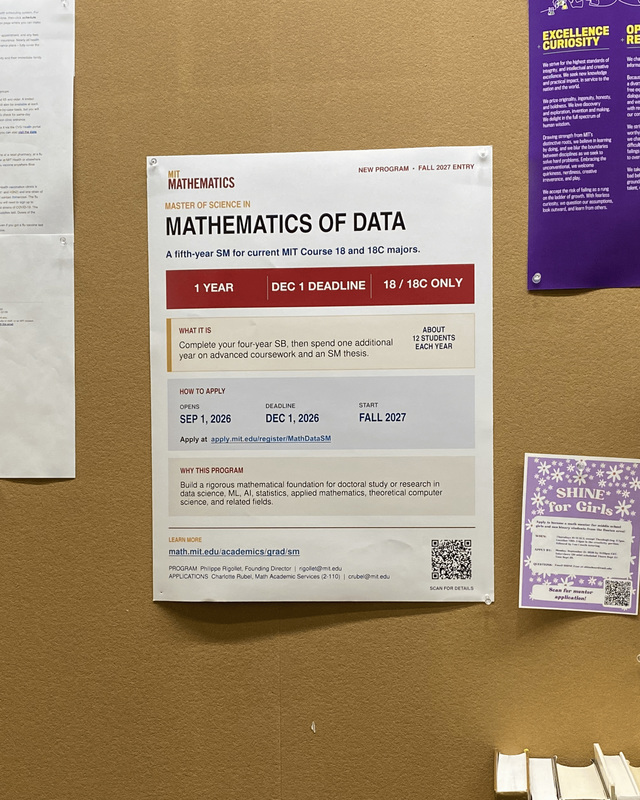
After years of solely offering PhD graduate programs, the MIT Mathematics Department has opened applications for a new master’s program, the Master of Science in Mathematics of Data (MMAD). It will function as a fifth-year master’s program only open to current undergraduates majoring in mathematics (Course 18) or Mathematics with Computer Science (18C). Next fall, around a dozen students will begin a year of graduate coursework and thesis research on the math behind data science and machine learning.
In a written statement to The Tech, Cecil and Ida Green Distinguished Professor of Mathematics and MMAD faculty chair Philippe Rigollet explained that the math department founded the program in response to increasing student interest in the theory behind artificial intelligence.
However, extensive major requirements can limit undergraduates from taking many AI-related courses. “It is difficult to combine that breadth [of required foundational knowledge] with substantial specialization in probability, statistics, optimization, machine learning, and related areas within a four-year undergraduate degree,” Rigollet wrote.
Through the master’s program, Rigollet hopes math undergraduates will be well prepared for either PhD programs or “careers in mathematically sophisticated, data-intensive fields.” However, according to MIT’s Career Advising and Professional Development Graduating Student Exit Survey, 82% of master’s students work in industry after graduating, and it’s too early to say if MMAD alumni’s post-graduate plans will be any different.
Bring on the master’s programs
MMAD isn’t the only new master’s-only program at MIT. Last July, MIT Sloan School of Management announced the formation of its Evening Master of Business Administration (MBA) program, and is planning to welcome its first cohort in August 2027. Evening MBA students will spend 22 months working full-time while attending online classes and going to Sloan for in-person sessions two evenings a week.
“Right now in higher education, it is an especially important time to continue to innovate,” said John C Head III Dean of MIT Sloan Richard M. Locke. Sloan announced the Evening MBA after market research revealed that working professionals are increasingly interested in getting a business degree, but don’t want to leave their jobs, Locke explained.
Though Rigollet and Locke stressed that their new programs were not developed in response to funding cuts, some departments are considering offering master’s programs as a way to increase revenue. After MIT’s federal funding decreased by over 20% last spring, Provost Anantha P. Chandrakasan and Chancellor Melissa Nobles announced the formation of an Institute-wide Committee on Exploring Master’s-Only Programs, which would decide whether “expanding [MIT’s] educational offerings will serve to advance our mission and generate additional revenue.”
According to Rigollet, for the math department, the funding cuts mean that the PhD program will gradually shrink, eventually hosting up to 25 fewer PhD students. Though he emphasized that the decrease in PhD students and the development of the master’s program are “largely separate,” the new MMAD students should not increase competition for resources. MMAD students will not get their own offices, since they will primarily be doing coursework and not research. They will also be responsible for arranging their own funding, which will come from Research Assistantships with faculty or Teaching Assistantships in courses like linear algebra, probability, and statistics. By contrast, math PhD students are typically guaranteed financial support, but are often assigned Research Assistantships or Teaching Assistantships after their first year.
If budget constraints continue, it is possible that other departments will follow suit, broadening their own master’s offerings. The Committee on Exploring Master’s-Only Programs, which has not yet responded to requests for comment, is expected to submit a report on its findings by Oct. 30.