MIT GSU prepares for a strike after months of unfruitful negotiation
So far, MIT and the GSU have reached agreement on three of 26 proposed articles






Photo provided by Lauren Chua/MIT GSU
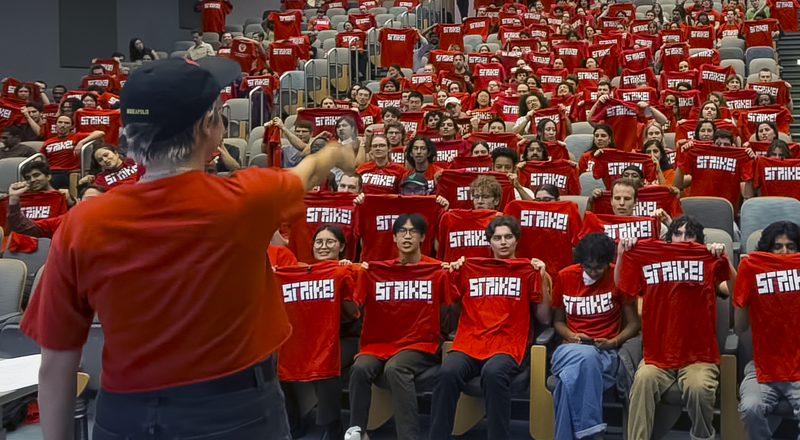
Photo provided by Lauren Chua/MIT GSU
Since April, MIT’s bargaining team and its graduate student union (GSU) have held multiple meetings to negotiate a second collective bargaining agreement, reaching tentative agreement on three of 26 proposed articles. The original contract expired on May 31, leaving around 5,000 graduate research assistants, teaching assistants, and Instructor-Gs working under the terms of the expired agreement.
After months of stagnant bargaining, the GSU launched a pledge on September 9 to strike if necessary. In a press release dated Sept. 11, 2026, the union announced that over 1,000 graduate workers have signed. It is not clear when exactly the GSU is planning to strike, but the last bargaining session in the month is planned for September 25.
Background
Negotiations started on April 24 with a rally at Hockfield Court with priorities derived from a Fall 2025 survey of nearly 1,800 union members.
In the last week of May, MIT suggested a 12-month extension to the existing contract and an immediate 3% raise. The union stated that MIT presented the offer late at night, marked it as non-negotiable, and set a two-day deadline. At 1 p.m. on May 28, during Commencement, graduate students protested on 77 Massachusetts Avenue.
On June 1, the union rejected the offer without presenting it to the members for a vote and countered with a three-month extension instead. MIT rejected the counter-proposal, expressing a preference for long-term stability amid what Vice Chancellor for Graduate and Undergraduate Education David L. Darmofal called “a period of significant research funding uncertainty” in an email to the MIT community.
In July, President Trump signed a bill imposing an 8% tax on the annual investment return from university endowments, which, according to leadership, cost around 10% of MIT’s annual central budget and resulted in a 16% decrease in “campus direct research activity charged to federal grants.”
Darmofal later stated that since the union rejected the offer, bargaining unit members would not get a raise until a new agreement is finalized and that most conditions of the expired contract continue to apply in the meantime. Pay, benefits, and dues will continue to be deducted as before, and MIT will keep deducting dues and agency fees unless an individual withdraws their check-off card.
International students
The union’s Article 12 proposal would, among other provisions, bar MIT from voluntarily consenting to immigration enforcement in classrooms, labs, offices, and dormitories; require notice to the employee and union within 24 hours of any government information request, along with a two-business-day waiting period and validity check; guarantee remote work without loss of pay when a visa prevents physical presence; and extend protections to DACA recipients.
Andy Liu, a 3rd year PhD candidate in the Chemical Engineering Department and an international student from Canada, considers the Trump Administration’s threats against international student statuses as a pressing issue to his quality of life. Citing a shared fear among the international communities on campus, Liu called out MIT for refusing to guarantee these common sense protections.
In an interview with The Tech, GSU president Lauren Chua G stated that around 40% of the covered graduate workers in the union are international workers. “It's a significant portion of our membership, and it's a huge priority for everybody that international workers get the protections they need,” she said.
MIT has recognized the importance of the issue and expressed its support for international students, yet the union claims it has refused to formalize the protections and reserved the option to exclude them.
Fellows
Since the union’s April 2022 election, the status of graduate fellows has been contested. In March 2023, a National Labor Relations Board regional director determined that fellows are not considered employees under federal labor law since they are not obligated to provide services for funding, a ruling the Board chose not to revisit in July 2024.
MIT relies on that ruling and adds two more arguments: first, classifying thesis research as employment would subject international students to the 20-hour weekly work limit under immigration regulations, which the regional director considered a significant disadvantage; secondly, granting bargaining-unit status would limit fellows’ flexibility in research and transitional funding.
The union asserts that fellows often carry out the same tasks as research assistants and teaching assistants but are left out of the contract’s protections against discrimination and disciplinary actions, highlighting departments such as Biological Engineering and Chemical Engineering that allegedly cut fellow pay bonuses without warning.
Pay and benefits
The union presented its opening economic package on June 17, more than seven weeks into talks. It included a 10% raise effective June 1, 2026, backdated, followed by 3% in 2027 and 3% in 2028, 20 vacation days regardless of appointment length, Institute-paid dependent health premiums, and several new support funds. It requested that raises be funded by the central Institute budget instead of principal investigators’ grants.
On August 13, MIT proposed a 2.75% raise and an 2.25% raise starting June 1, 2027. The union countered with 7.75% for year 1, followed by 3.5% and 3.25% for years 2 and 3 on September 14.
A living wage
The union cites the MIT-hosted Living Wage Calculator in its demands, noting it shows graduate workers earn 76% of the minimum living standard in the Cambridge-Boston area, alongside a January 2025 Graduate Student Council cost-of-living survey indicating that workers need roughly $60,000 per year to afford average rent without financial pressure.
MIT published its own analysis on August 20, asserting that the calculator’s assumptions do not apply to its students. By their calculations, the estimated living wage is $46,500, which is about 10% lower than MIT’s current FY26 minimum 12-month PhD RA stipend of $51,200. MIT also published stipend comparisons on August 21 showing its FY27 minimum 12-month RA stipend of $52,500 above every Boston-area peer and most of the Ivy+ group.
Chua claimed that, despite MIT's “alarmist statements about funding difficulties,” the Institute is still well-funded and fully able to support all its employees, graduate students, as well as facilities and library staff.
Health care
Health care emerged as a flash point in July. MIT’s Management Rights proposal seeks to eliminate the obligation that any changes in insurance providers must preserve equal or superior benefits, while its Medical Benefits proposal aims to replace the current baseline, fixed at the Oct. 1, 2022 level, with coverage matching that of non-bargaining-unit students, as adjusted by the Institute over time.
The union claims this would terminate the guarantee of benefits, such as 52 weeks of covered therapy, and has pointed out that SHIP enrollment records now indicate a fall term from Sept. 1 to Jan. 31 instead of a full year (Figure 6). When asked about the change at the table, MIT said it was not planning to change anything for now.
The union’s counterproposals move in the opposite direction of MIT’s, offering dependent coverage without premium costs, a benefits floor reset to May 31, 2026, and a Health Care Assistance Fund of at least $400,000 per year to cover out-of-pocket expenses. On August 6, the GSU held a health care town hall outside MIT Health.
In a statement to The Tech, Hannah Margolis G, a graduate student in the Lamason Lab, pointed to the closure of MIT Health’s (then MIT Medical) pharmacy in 2022, the phaseout of on-demand COVID testing, and other cuts as examples to why including health care provisions in the contract is important. Margolis credits the union contract won in 2023, which added health provisions such as 52 free therapy sessions per year, as the sole reason she was able to complete her graduate work. Margolis had been hospitalized in her first year after failing to get access to a proper diagnosis and health coverage for managing symptoms. “If there is one thing I’ve learned about MIT during my five years as a PhD student, it’s that they love to cut costs at the expense of worker health and safety,” she said.
Disciplinary protections
MIT has stated unequivocally that it will not negotiate academic issues, claiming that an external arbitrator might otherwise reverse grades, qualifying exam outcomes, or degree awards, and pointing out that no comparable institution has consented to binding arbitration on academic assessments. It points to the Graduate Academic Performance Group, departmental committees, and the Committee on Discipline as existing avenues.
The GSU pushed back on the framing, clarifying that an arbitrator would only concentrate on assessing the consequences of poor academic performance, rather than deciding whether poor academic performance actually occurred. For example, they would verify whether standards were clear, consistently applied, and preceded by a chance to improve. The union pointed to a similar protection at Cornell which allows disputes concerning the procedures and processes around academic decisions to be subject to the grievance and arbitration provisions.
“Essentially, what we're dealing with is an employer, MIT, who will label anything and everything as academic as a way to circumvent the rights and protections enjoyed by union members,” said Chua. “The issue is less about wanting direct oversight over academic matters themselves, and more about closing a loophole that MIT has created to deny graduate workers their contractual rights to fair treatment.”
Union security
On May 11, MIT proposed converting the current agency shop, under which all bargaining unit members either pay dues as members or equivalent fees, into an open shop where payment is voluntary.
The Institute argues that students should not be required to pay thousands of dollars to a national union as a condition of holding an appointment, that non-payers would benefit from the contract regardless, and that some students have raised religious or ideological objections. It points to the Supreme Court’s 2018 Janus v. AFSCME decision barring agency fees in the public sector and to right-to-work laws in more than half of the U.S. MIT has also opposed a clause permitting the union to require termination of an appointment a week early (penalizing a student around $1,000 in wages) because of unpaid dues or fees, which it claims the union has tried to enforce over amounts as low as $5.
The union labels the proposal as union-busting and argues that an open shop would shift its efforts to recruitment while leaving the enforcement costs to a decreasing number of dues-paying members.
In a statement to The Tech, Chua highlighted Reverend Dr. Martin Luther King Jr.'s criticism of open shop policies as an effort to weaken labor unions, thereby reducing wages and infringing on civil rights: “During our first contract negotiations, over 88% of graduate workers voted down MIT’s open shop proposal. The majority of grads were prepared to strike to win union shop in 2023, and we are prepared to do that again to ensure that we can maintain this critical provision.”
A potential strike
Following the same escalation pattern that led to a tentative agreement on the initial contract in September 2023, the union has begun preparing for a strike.
The union has combined bargaining with a public campaign, expanding their allyship to undergraduate students that they claim could be impacted by changes to MIT SHIP. It has also started to circulate a solidarity petition.
A strike would need a majority strike pledge. Then, a strike authorization vote would open to all card-signing members, including fellows and master’s students. After, the bargaining committee would determine whether and when to initiate the walkout. The union regained the right to strike when the contract’s no-strike clause lapsed on May 31.
MIT has said it remains committed to bargaining in good faith while maintaining that several union proposals fall outside the required topics of negotiation.
“A strike is not inevitable,” said Chua. “MIT can choose at any time to meet the needs of its graduate workers and meet our demands to have a contract that protects our healthcare, our union, and our rights.”