Success doesn’t guarantee loyalty: How the Celtics lost Jaylen Brown
Despite winning a championship in 2024, the Celtics’ repeated attempts to trade Finals MVP Jaylen Brown may have finally come at a cost





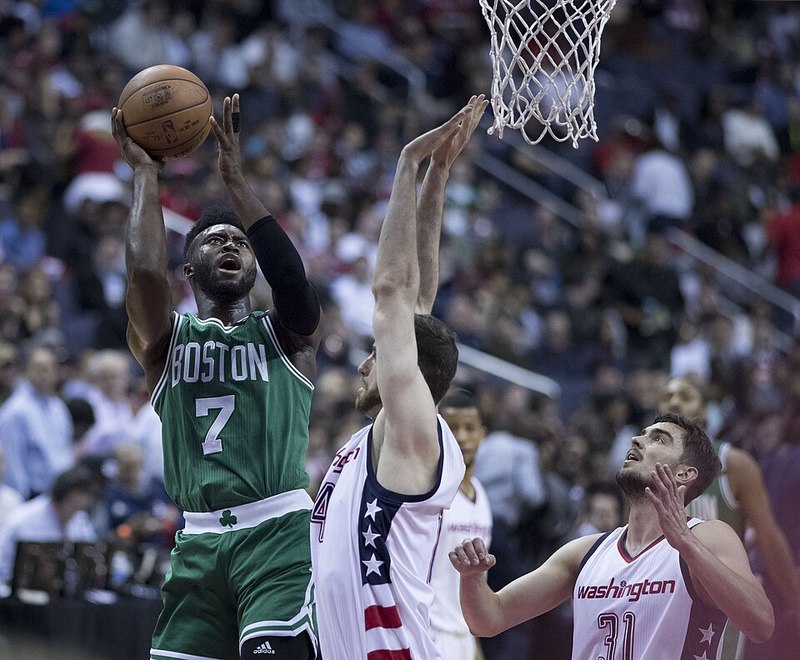
Photo from Keith Allison/Wikimedia Commons (CC BY-SA 2.0 Generic)
After blowing a 3-1 series lead to the Philadelphia 76ers in the 2026 NBA Playoffs, the Boston Celtics were expected to make minor adjustments to their roster centered around superstars Jaylen Brown and Jayson Tatum. The two had been arguably the most successful duo since 2017, appearing in five Eastern Conference finals and two NBA Finals, with one appearance being Boston’s dominant 2024 championship run that resulted in Brown earning Finals MVP. As Tatum had recently returned from an Achilles tear, many fans and analysts believed that the team should run it back next season with a fully healthy roster.
Instead, the Celtics front office had different plans. On July 1, ESPN insider Shams Charania announced that the Celtics were trading Jaylen Brown to the 76ers for Paul George, two first-round picks, and two second-round picks. Fans were left in disbelief — not only did the team give up their homegrown talent who had blossomed into an All-NBA-level guard, they also traded him to one of the Celtics’ biggest rivals for George, a 36-year-old forward who has sustained several injuries since 2019. Historically, when a player of Brown’s caliber is moved, the star is the one requesting the trade, prompting the organization to explore their options to maximize their return with players and draft assets. However, this situation is a lot more complex due to personal agendas and newly established salary cap rules clashing with each other.
It’s no secret that the Celtics have shopped Brown in the past few years. Even after reaching the Finals in 2022, the Celtics heard that two-time Finals MVP Kevin Durant requested a trade and offered Brown in a package deal. After the trade fell through due to Brooklyn’s extremely high asking price, Brown mended his relationship with the organization to make the Finals in 2024 and win Finals MVP, cementing himself amongst Celtics legends. But in the NBA, success does not guarantee loyalty.
In the summer of 2026, it was known across the league that former two-time MVP and Defensive Player of the Year Giannis Antetokounmpo wanted out of the Milwaukee Bucks. The Celtics, yet again, pounced on the opportunity to trade for an elite-level talent by offering Jaylen Brown and two unprotected first-round picks. Compared to 2022, this deal felt like an all-or-nothing move from the front office. Brown had just spent the last year carrying a depleted roster to second in the East, earning All-NBA honors and MVP chants en route to his best individual season ever. This offer was a direct slap in the face: it established that the Celtics still viewed Jayson Tatum as the unquestioned number one option to build around.
The Bucks asked the Celtics to also include Hugo Gonzalez and Baylor Scheierman in the deal, but they were unwilling to part with their young prospects. The deal fell through again, and the Bucks eventually agreed to send Antetokounmpo to the Miami Heat, another fierce rival who stopped the Celtics’ title runs in 2020 and 2023. Brown had every right to demand a trade.
He did not.
But from the outside, it was clear that the Celtics had pushed things too far and fractured their relationship with one of their franchise cornerstones beyond repair.
The media reports began to spiral out of control. ESPN insider Bobby Marks reported that an anonymous source called Brown “the seventh-best player” on his own team based on analytics. Brown fired back on X, stating that no one has won more regular season and playoff games combined since he came into the league. With the relationship souring each day, the Celtics gave into the pressure and listened to trade offers from eight to team teams.
But the Celtics had shot themselves in the foot. Everyone knew that they were actively shopping Brown, which meant they had zero leverage in any negotiations. The Golden State Warriors’ front office could not agree on whether Brown could lead the franchise post-Stephen Curry, showing that the “seventh-best player” comments had significantly damaged his reputation. The Celtics’ initial asking price for the 76ers was Paul George, rookie phenom V.J. Edgecombe, and four first-round picks, yet they ended up settling for significantly less.
Following the trade, President of Basketball Operations Brad Stevens and owner Bill Chisholm held a joint press conference. Stevens explained the trade from a financial flexibility standpoint: while the organization deeply appreciated Brown for his contributions, he would be eligible for a supermax contract worth 35% of the salary cap. With Jayson Tatum having secured a supermax contract through 2030, two players consuming 70% of the cap was no longer viable with the new second apron rules.
Before the current Collective Bargaining Agreement (CBA), teams that would spend more than the salary cap would simply have to pay the luxury tax. From 2015 to 2022, the Warriors paid the most luxury tax compared to any other team, keeping their core intact and winning four championships during that span. In their 2023-2024 campaign, the Celtics paid roughly $41 million in luxury tax, allowing them to bring in key players Jrue Holiday and Kristaps Porzingis en route to their championship.
By the 2024 offseason, the toughest restrictions of the new CBA kicked in, with teams exceeding the salary cap experiencing significant limitations in roster construction flexibility. The punishments for exceeding the second apron were especially harsh, as teams could no longer aggregate contracts in trades, trade first-round picks from seven years out, and faced even stricter rules the longer they were above the threshold. The Celtics had won a championship while flirting with this line — remaining there long term would be an entirely different problem.
The trade ultimately boiled down to two irreconcilable truths:
1) While the Celtics experienced tremendous success with their superstar duo, they also had to consider how they would survive with the new CBA. They had no choice but to protect the future of a franchise trapped in its own success, a team that became impossible to keep intact due to new financial regulations.
2) Jaylen Brown is one of the top-end talents in the current NBA both offensively and defensively, and is one of 34 legends that has earned Finals MVP. Despite finishing the best individual season of his career, he was treated more like a problem instead of a solution.
But numbers never tell the whole story. Brown’s decade-long tenure in Boston will be remembered not only for the Celtics’ historic 18th championship, but also for what he built off the court. Brown was not shy to use his platform to advocate for education, social justice, and economic opportunities instead of simply building a personal brand. As an MIT Media Lab Director’s Fellow, he organized the Bridge Program as a collaboration between his 7uice Foundation and the MIT Media Lab, exposing students from underrepresented communities to STEM, robotics, AI, and entrepreneurship. Whether or not the trade proves to be the right basketball decision, Brown leaves Boston with a lasting impact on the city beyond the final buzzer.
A correction was made on Aug. 8, 2026: An earlier version of this article misstated that Paul George was a point guard. He is a forward.