Zachary Abel on finding the factorial of 1/2
Assuming only a pre-calculus math background, the answer circles surprising connections





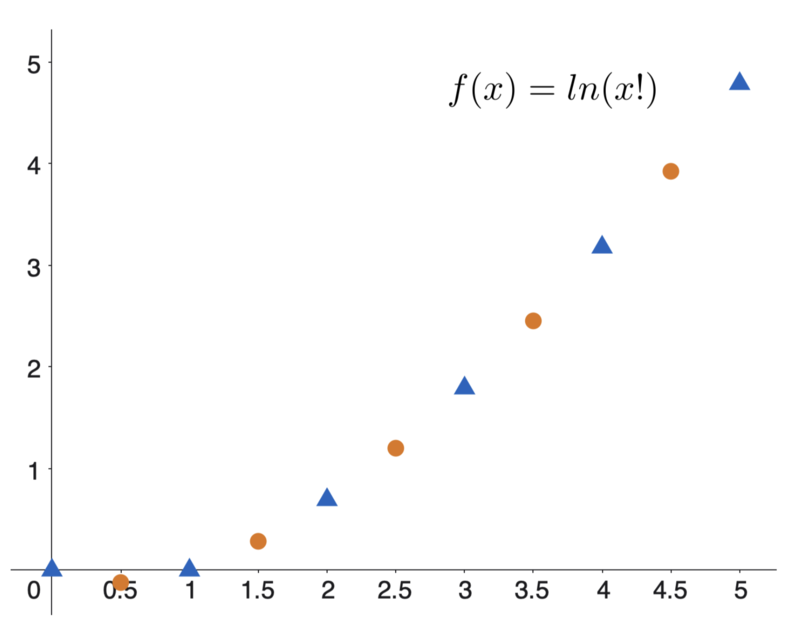
Photo provided by Elizabeth Li
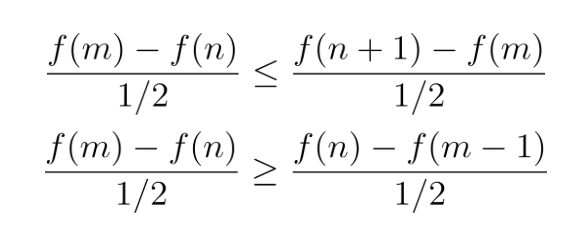
Photo provided by Elizabeth Li
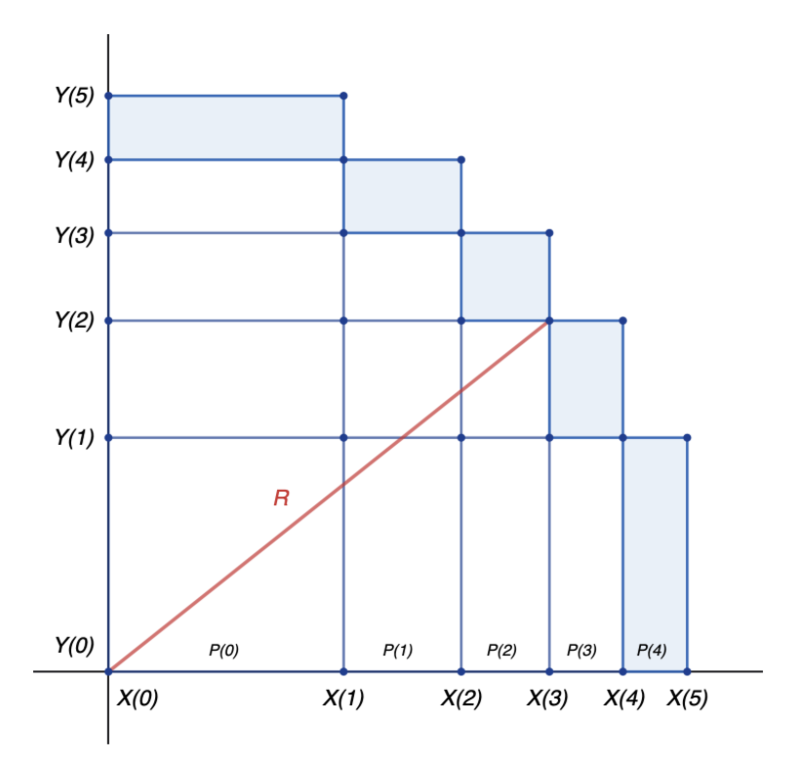
Photo provided by Elizabeth Li
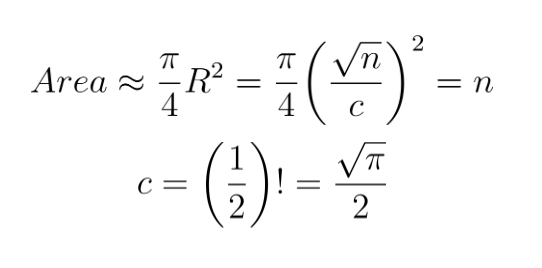
Photo provided by Elizabeth Li
You may recognize the concept of the factorial of a nonnegative integer n, denoted as n! := n · (n - 1) · (n - 2) · … · 2 · 1, from an introductory combinatorics or probability class. For instance, the number of ways to shuffle a standard 52-card deck is 52! — 52 choices for the first card, multiplied by 51 (52 minus the first card we already chose) for the second card, and so on. But it turns out that it’s also possible to compute the factorial for some non-integers.
On April 28, 2026, the Undergraduate Math Association (UMA) invited Zachary Abel PhD ’16 to speak on finding the factorial of 1/2. This talk, originally planned at an advanced high school level for students attending the Canada/USA Mathcamp, provided an innovative perspective on the topic: it uses only a fundamental knowledge of functions without calculus, analysis, or ideas from complex analysis like the Gamma function T(z), a continuous extension of the factorial function that takes a domain of positive real numbers instead of nonnegative integers.
Since obtaining his graduate degree from the Department of Mathematics in 2016, Abel has worked as a Principal Lecturer in the MIT Computer Science and Artificial Intelligence Lab (CSAIL). His research in computational geometry lies in the intersection of discrete geometry and algorithms, with applications to origami or reconfiguration algorithms.
Throughout the talk, Abel provided animations to present every key aspect of the argument without losing any details of its nuance. More importantly, by defining what kind of math could be used in the talk, Abels indirectly demonstrated the nature of mathematical research, which often involves many good ideas and attempts rather than advanced theory.
Quest for the factorial of 1/2
The recursive form of the factorial formula n! = n · (n - 1)! can still be applied to any positive half-integer, assuming that some closed-form expression c exists that is exactly the value of (1/2)!. For example, we can write (3/2)! = (3/2) · c = (3/2) · (1/2)!.
This discrete formula for the factorial unfortunately breaks down when we consider (1/2)! itself, as numbers in the factorial expansion cannot go into negative numbers (which (1/2 - 1)! would require). Consequently, this problem calls for a different approach. Abel proposed plotting the function f(x) = ln(x!) over two sets of points, the integers and the half-integers, before adjusting c so the two sets of points interpolate to lie on one smooth function (see Figure 1). In this case, the graph is convex (meaning that it has a “U” shape), which guarantees its continuity.
Convexity is important because it implies that the slope increases as the input increases. Therefore, for any half-integer point (m, f(m)) where m = (2n + 1)/2 such that n a nonnegative integer, we can simply compare the slope between this half-integer point and points adjacent to it to get an upper and lower bound on c (see Figure 2).
As n approaches infinity, these two bounds converge to the exact value of c. However, this calculation-intensive approach, despite producing the right answer and providing some early intuition about the goal of this problem, requires some use of the Central Limit Theorem (typically taught in a probability class), which is material beyond the assumed background of this talk. This is where Abel pivoted to finding the limit through a reinterpretation of the bounds with a probabilistic game.
Imagine a bag with one blue ball and one red ball. On each turn, you pick a ball with replacement from the bag, note the color of the ball you picked, and then add two identical balls of the same color into the bag. This can continue for any number of draws, where balls of the same color are indistinguishable.
For example, suppose you want to draw two red balls consecutively. Drawing the first red ball has probability 1/2, and drawing the second red ball (after replacing the ball you drew on the first round and adding two more red balls to the bag) is 3/4, so the total probability is (1/2) · (3/4).
In fact, the probability of drawing n red balls consecutively is defined as P(n) = (1/2) · (3/4) · … · (2n-1)/(2n). The bounds we have from earlier (see Figure 2) allows us to approximate c ≈ 1/(2 · sqrt(n) · P(n)) by simply manipulating the expression.
To visualize the problem, Abel defined a grid where the width of each box was exactly P(0) = 1, P(1), …, P(n) (see Figure 3). Here, the difference between consecutive increments X(n+1) - X(n) by definition equals P(n), so we can relate the two by X(n) = 2n · P(n). Define Y(n) in the same way.
Figure 3. The quarter circle visualization for the calculation of c.
Now, using the Pythagorean Theorem, we can find the radius R, which is the hypotenuse of a triangle with sides X(k) and X(n-k). Specifically, R ≈ sqrt(n)/c.
In terms of the probabilistic game, the area of the boxes on each diagonal (the highlighted boxes are on the fifth diagonal) is the sum of the probabilities of all possible combinations of red and blue balls drawn given a fixed number of total draws. Naturally, it sums to one.
Therefore, these two ways of calculating the area of the quarter circle, one using the approximate radius R and the other as a characteristic of the game we have defined, are set to be equal to solve for c, which is of course, (1/2)!.
An expert in engaging the audience
Abel, who is also a longtime lecturer of 6.1200 (Mathematics for Computer Science), is no stranger to giving talks to math enthusiasts. From his experience teaching, he finds that visualizations that clearly demonstrate conceptual properties will instantly capture more attention.
“Honestly, anything to break the monotony of writing on a chalkboard,” he quipped.
A memorable demonstration that Abel always does for his 6.1200 students is performing a merge sort with stuffed animals of various heights, which he brings from home. By first arranging randomly in a line and sorting them, “the movement [of] doing an exchanging in merge sort and seeing the stuffed animals switch positions, instead of erasing and writing a new number on the board, makes the learning experience more visceral,” Abel said.
While this was Abel’s first time speaking as part of the UMA Lecture Series, the organization has invited over half a dozen speakers over the course of the past semester. UMA Academic Committee Co-Chairs Joy Ren ’28 and Tiffany Zhang ’28 shed more light on the behind-the-scenes organizational process.
“I think it’s a really cool opportunity for students to be able to gain a little insight into the current research questions of the field, because it’s quite different from what they could learn in an undergraduate class or project,” Ren said.
For those interested in learning more about what professors are working on (or in doing research in particular), there are further opportunities beyond these biweekly lectures. On May 1, the UMA hosted a faculty dinner with Shen Shen SM ’14 PhD ’20 PD ’21, a lecturer in the EECS department at MIT whose research specializes in optimization and robotics. This event, which arose out of a prior talk that Shen gave at the UMA, was open to any students interested in having a more in-depth conversation with the speaker.
As to how the speakers are selected, those first considered are usually former or current professors who have taught classes that UMA staff members have taken or are taking. To encourage the diversity of topics and lecturers, there is ideally a one-semester gap before the same speaker is invited again.
With regards to the noticeable increase in machine learning and artificial intelligence topics, Zhang noted that the potential bias could have arisen from many of the UMA staff being double majors in Course 18 and Course 6. “All the people we contact are in Course 6 or Course 6-adjacent math classes, so in that sense, the speakers would inevitably talk more about AI,” Zhang explained. “We usually try to prioritize people who are not in Course 6, but we also want to make sure we have as many speakers as possible."
Given the diversity and frequency of UMA professor talks, those looking to enrich their math experience outside of class or satisfy their curiosity about interesting math facts may find these events worthwhile. Updates about additional talks will be announced by the UMA throughout the next academic year.