Amid security concerns, MIT to spend over $3 million on over 500 new surveillance cameras across campus
New cameras have real-time AI face and object detection; some have omnidirectional field of view





News Staff – THE TECH
News Staff – THE TECH
Look up the next time you stroll down the Infinite Corridor, and you might see a new surveillance camera looking back at you.
According to information obtained by The Tech, MIT is spending over $3 million on more than 500 AI surveillance cameras in academic buildings, residence halls, and outdoor areas along Memorial Drive. Installation of the new cameras, along with the wiring and infrastructure that will support them, began November 2025 and will likely continue until September 2026.
Technical specifications for the cameras suggest that they will be capable of collecting real-time face and object classification data, including detection of motion, loitering, crowds, face masks, and camera tampering. Individuals can also be automatically classified on the basis of clothing color, gender, and age, up to a distance of 35 feet (11 meters) from the camera. According to a statement from MIT spokesperson Kimberly Allen, any collected data is “retained up to 30 days,” unless an exception is granted.
The new cameras are the first part of a multi-phase project to expand surveillance coverage across campus. The Tech was not able to obtain details about any subsequent phases of this project.
The new deployment, which is being coordinated by the Campus Safety Working Group, reflects a broader trend of universities bolstering their surveillance infrastructure. The University of Pennsylvania’s outdoor camera network, for instance, has grown by roughly 20% over the past five years, according to a February 2026 report by The Daily Pennsylvanian.
Brown University also appears to be following suit in the wake of the December shooting on its campus that left two dead, according to a letter from administrators that announced imminent expansions of its camera network.
However, Allen stressed that the impetus for MIT’s surveillance expansion was unrelated to the Brown shooting or the December 2025 shooting of Professor Nuno Loureiro in his Brookline residence. She noted that the project had already been underway at the time of the shooting.
These changes come even as MIT is facing substantial budget cuts from federal actions, which have triggered hiring freezes for most staff positions, salary freezes, and the effective closure of multiple libraries.
Interior and exterior camera expansion
The bulk of the project’s cost will be awarded to Siemens, a German automation company, whose proposal outlines the deployment of 521 cameras across MIT’s academic buildings for nearly $2 million. Of these, 501 will be single-lens models and 20 will be quad-lens, which are designed to capture a broad, omnidirectional range of angles simultaneously.
Along with Siemens, telecommunications contractors LCN and Picardi Electric will be involved, chiefly for excavation work as well as conduit and mount installation. These contractors appear to be common choices for similar campus infrastructure projects.
Plans also call for 67 exterior cameras to be deployed across several locations along Memorial Drive and near residential buildings. These installations will include a mix of building-mounted quad-lens and single-lens cameras on upgraded or new emergency call towers. Notably, the project will also add 13 new “Code Blue” emergency phone towers.
All undergraduate dorms along Memorial Drive and Killian Court are among the areas slated for additional coverage.
Technology and concerns
The primary supplier for the new cameras will be surveillance company Hanwha Vision, formerly known as Hanwha Techwin or Samsung Techwin. In addition to video surveillance, the company has also historically developed industrial automation and weapons technology products, until a 2017 restructuring left these products in the hands of subsidiaries.
Most of the new cameras, which are part of Hanwha’s Wisenet AI line, are marketed for their ability to identify and classify multiple objects with deep learning algorithms. They support resolutions ranging from 2MP to 4K while also recognizing faces, license plates, vehicles, and other objects in real time.
Nearly all cameras will accommodate a wide range of pan, tilt, rotate, and zoom motion and will be monitored continually with Ai-RGUS, an AI camera software.
When questioned about the new cameras, Allen said that they were “part of regular efforts to promote campus security.”
“The safety of our community is always a top priority,” Allen added. She also noted that the cameras’ audio recording features are disabled — a requirement imposed by law.
While Information Security and Technology (IS&T) policies on cameras forbid their use for disciplinary matters, MIT Police has made repeated use of video surveillance in the past to identify suspects — outsiders and members of the MIT community alike — for potential infractions, as evident in recordings of police radio.
Some students expressed concerns about the use of the new cameras in this way, along with their implications for privacy.
Evan Lofink ’27 was worried that the cameras would be used to crack down on student demonstrators, and called on the Institute to follow the lead of the City of Cambridge, which terminated its contract with surveillance company Flock in December.
“History has shown us that surveillance states exist not to protect innocent people from criminals, but to make criminals of innocent people,” Lofink said. “We have seen this phenomenon play out at MIT, where the ratcheting up of tracking systems and police presence over the past years have done little other for the community than assist in witch hunts against student protestors.”
Others, including Jayna Ekelmann ’27, said they recognized the motives of the project but were unsure if the measures would ultimately be effective.
“I understand the motivation behind [the new cameras], but I am not convinced that many more cameras in the hallway is useful in preventing anything. Seeing cameras everywhere I go makes me uncomfortable,” Ekelmann said.
Technical information
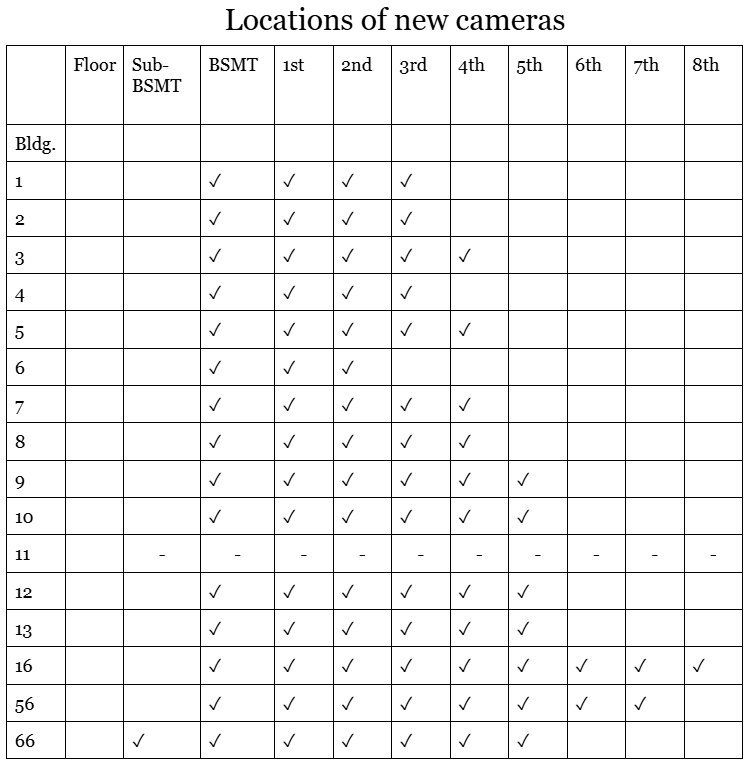
According to documents reviewed by The Tech, LCN proposed a total of $419,250 for installations in Buildings 1, 2, 3, 4, 5, 6, 6C, 7, 8, 9, 10, 11, 12, 13, 16, 56, and 66. Picardi Electric’s main campus work was quoted for $298,790. The largest single building quote in this proposal is for Building 16, at around $45,000, while Building 11 carries the smallest quoted cost, at around $6,000. Interior cameras will be installed (per Picardi Electric’s quote) as follows in FIGURE 1.
LCN also provided a quote for a camera project in buildings E51, E52, 51 (written as M51), 50 (written as M50), W5, W7, W8, W11, W71. W84, W85, and W98 for $18,000.
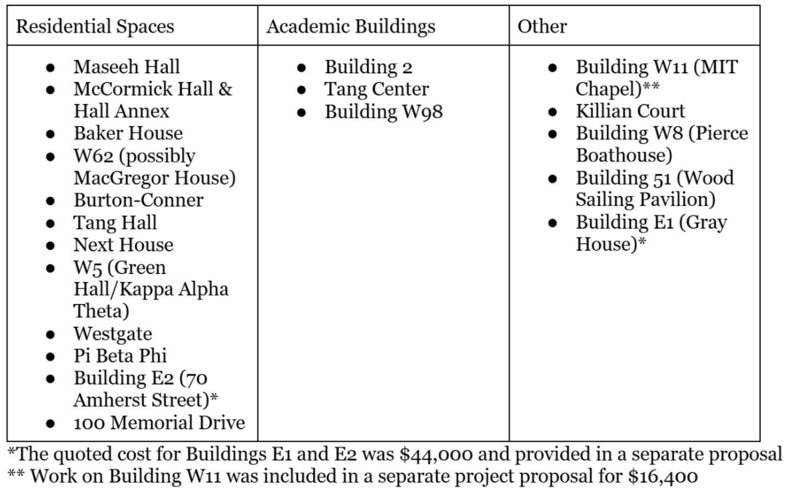
Picardi Electric proposed exterior camera work on buildings on Memorial Drive for a total of $377,400. Per their quotes, exterior cameras will be installed near the following locations in FIGURE 2.
Under Siemens’s proposal, the other 13 cameras will be part of new “Code Blue” emergency phone tower installations. Each tower will be equipped with an LS1000 emergency phone, forward-facing security cameras, public address systems, blue emergency lighting, and an overhead mount for quad-lens and PTZ cameras.